Dubai's AI Traffic Signals to Cut Congestion by 10%, RTA Confirms
Dubai's Roads and Transport Authority plans AI-driven traffic signals to reduce congestion by at least 10%, enhancing traffic flow and public services.
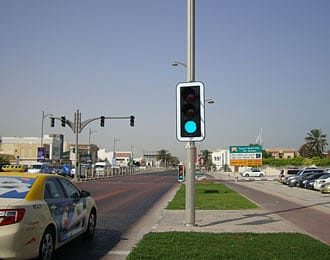
Dubai is set to implement artificial intelligence-powered traffic signals that are anticipated to decrease traffic congestion by a minimum of 10 percent, according to a senior official from the Roads and Transport Authority (RTA). This initiative is part of the emirate's broader strategy to leverage predictive technology for improved traffic management.
Ahmed Bahrozyan, CEO of RTA’s Corporate Technology Support Services Sector, revealed on Dubai Radio’s Direct Line programme that efforts are underway to link all traffic signals in Dubai to the RTA’s traffic management centre located in Al Barsha. This integration is expected to be completed by early next year.
The AI system will utilize data collected from cameras and existing infrastructure to forecast traffic congestion and detect potential bottlenecks. Based on these predictions, signal timings will be adjusted dynamically to better accommodate real-time traffic conditions.
Bahrozyan highlighted that this technology will enhance the responsiveness of traffic-signal management compared to current methods. He projected that the implementation of these AI-driven systems will contribute to at least a 10 percent reduction in traffic congestion, alongside other ongoing projects aimed at easing traffic flow.
The RTA currently manages traffic signals through its Al Barsha centre and maintains constant coordination with Dubai Police to ensure smooth traffic operations.
This upgrade is a component of the RTA’s updated artificial intelligence strategy, which extends beyond traffic control to include public transport planning, customer service improvements, and infrastructure management.
AI to Simplify Motorist Services
Bahrozyan also mentioned that motorists will increasingly interact with AI assistants for services such as paying fines, renewing vehicle registrations, and renewing driving licences. This approach aims to streamline service access and boost departmental efficiency. The RTA expects that over half of its service operations will transition to an AI-assistant platform within the next two years.
The updated AI strategy is projected to deliver more than Dh300 million in annual added value through enhanced efficiency and improved public services.
Comprehensive AI Integration Across RTA
The strategy encompasses 41 different areas within RTA’s agencies, sectors, and departments, with extensive AI integration planned over two and a half years. The rollout is structured in six phases, with the first two currently underway and the remaining four scheduled over the next two years.
Priorities have been set to balance enhancements in public-facing services with internal operational efficiency. Besides transport operations, the strategy covers support functions such as contracts, procurement, finance, and human resources. AI will also assist in planning for buses, the Metro, and marine transport.
Given the rapid pace of technological advancement, the RTA reviews its AI strategy every six to twelve months to stay aligned with new developments.
Asset Management Using AI
Managing the RTA’s expanding infrastructure portfolio, valued at over Dh150 billion, is another critical focus area. With ongoing major transport and road projects increasing this portfolio, traditional monitoring methods relying on staff and inspectors are becoming less feasible.
AI technologies are expected to extend asset-monitoring capabilities to approximately five times the current coverage, enabling better maintenance and protection of infrastructure.
Traffic management and public transport operations will continue to be central to the RTA’s AI strategy, alongside efforts to simplify everyday services for residents.
What this means for you
- Dubai residents can expect reduced traffic congestion by at least 10 percent due to AI-managed traffic signals.
- Motorists will be able to use AI assistants for services like paying fines and renewing vehicle registrations and driving licences.
- More than half of RTA service operations will be accessible through AI assistants within two years, simplifying service processes.
- The RTA is enhancing infrastructure monitoring with AI to maintain and protect transport assets more effectively.